

Reconstructing the Hidden Lives of 14th-Century France
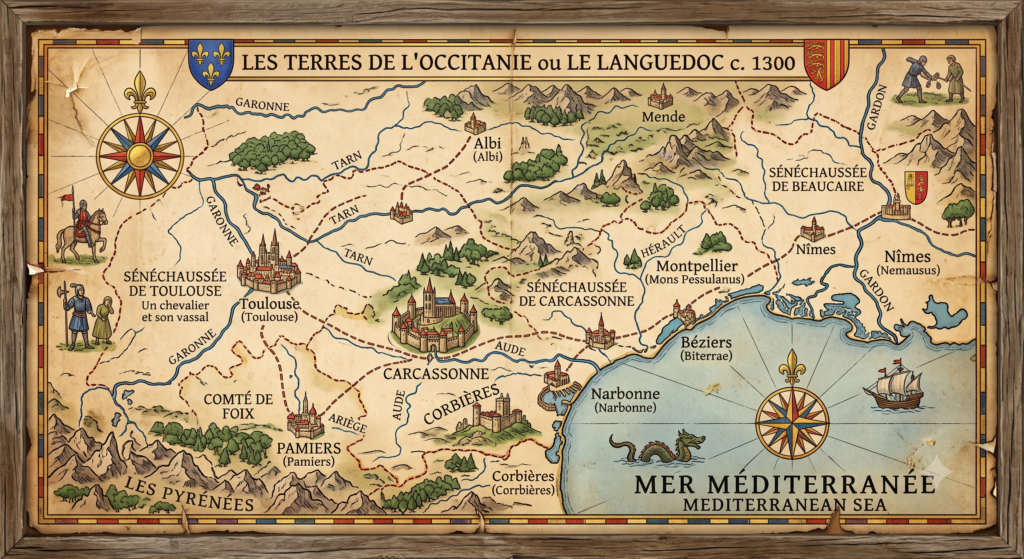
When I set out to write The Falcon and the Book, I wanted to avoid the “costume drama” version of history and tried to capture the grit, the scent of woodsmoke, and the reality of persecution and unchecked power that took by force what it wanted. To tell Amiel’s and Rachel’s story I needed to capture not just the grand historical framework we know of—the words and wars of the great men, the kings and popes– but the details of everyday life, the felt lives of those who lived in nameless villages, and those who lost their battles and fell into history’s cracks and crevices.
The Macro: A World Governed by Fear
The 14th century in France was an age of transition and terror. The vast forces of the state in the process of consolidating small principalities, and contesting with the power of Rome. And the Church likewise was not a mere spiritual guide; it was a political superpower. And one of its most powerful tools was the inquisition, which consider the church to be in a life and death struggle against a plethora of heresies that arose in reaction to the perception that the church had lost its way, and had become too rich and too comfortable with power..
In the story, these twin powers, their interests reflected in many of the novel’s characters, become a shadowy character themselves—an invisible, crushing vice that forces ordinary people to decide what they are willing to betray to stay alive.
The Micro: The Healer’s Reality
While the world of the 14’th century was burning with political ambition, characters like Rachel lived in a much smaller world, but one that mirrored the conflicts of the world around her.
Historical research for Rachel’s life as a healer involved digging into medieval herbalism and the precarious social standing of “wise women,” midwives and those who tended the sick without a degree from the University of Paris and were therefore luckily not trained in the universal theory of the humors that guided all licensed medical doctors of the time. While the universities attempted to curtail the work of the mainly female village healers—who readily blended their knowledge of the healing powers of plants with magical cures and remedies, the poor were generally too poor to employ university trained doctors. If the untrained herb women were under pressure from the universities, they were also subject to the attack from their neighbors and the church. If they healed someone, they were praised and rewarded but when sickness came and cures failed, they were vulnerable to charges of curses and doing harm. While the famous witch persecutions and trials were to come later in this century, the whispers and accusations had already begun to be heard. This is the world where Rachel finds herself, surrounded by enemies willing to use the latent and explosive charges of witchcraft and heresy to achieve their ends.
Why the Past Still Matters
Why write about the 1300s in 2026? Because the human experience remains stubbornly consistent. Barbara Tuchman’s history of the century was titled “A Distant Mirror.” A mirror, because we easily recognize ourselves in these people who lived so long ago; and distant because the images the mirror shows us are also jarringly different in many ways. Who today would find bear baiting (dogs and a chained bear tearing each other to pieces) or public executions by disemboweling, quartering or death by burning, were treated as a form of entertainment? O.K., maybe a few, hopefully not my neighbors. And yet, how different are we? Do we not do almost the same when we watch these acts simulated in movies and read about them in books?
The Falcon and the Book is a journey through a world of shadows, but at its heart, it is a story about the light—the small, flickering flame of truth that survives even the darkest of centuries. The struggle to speak the truth about our world when silence is the safer option is not a medieval or a modern phenomenon—it is a human one.
***
If you have ever wondered what daily life was really like during the Middle Ages? For example, how did people in Paris in 1320 get water to cook or wash in? Or how often they bathed? Or how many different official occupations with guilds there were in that time? Feel free to send your questions, corrections and comments in the comments box below. I’ve done a fair amount of research and I’m happy to share.